Voronocity: Parametric Urban Morphology and the Logic of the Organic City
Voronoi-based urban morphology offers a mathematically grounded approach to generating city form from relational proximity data, producing organic block structures that enhance accessibility and ecological performance.
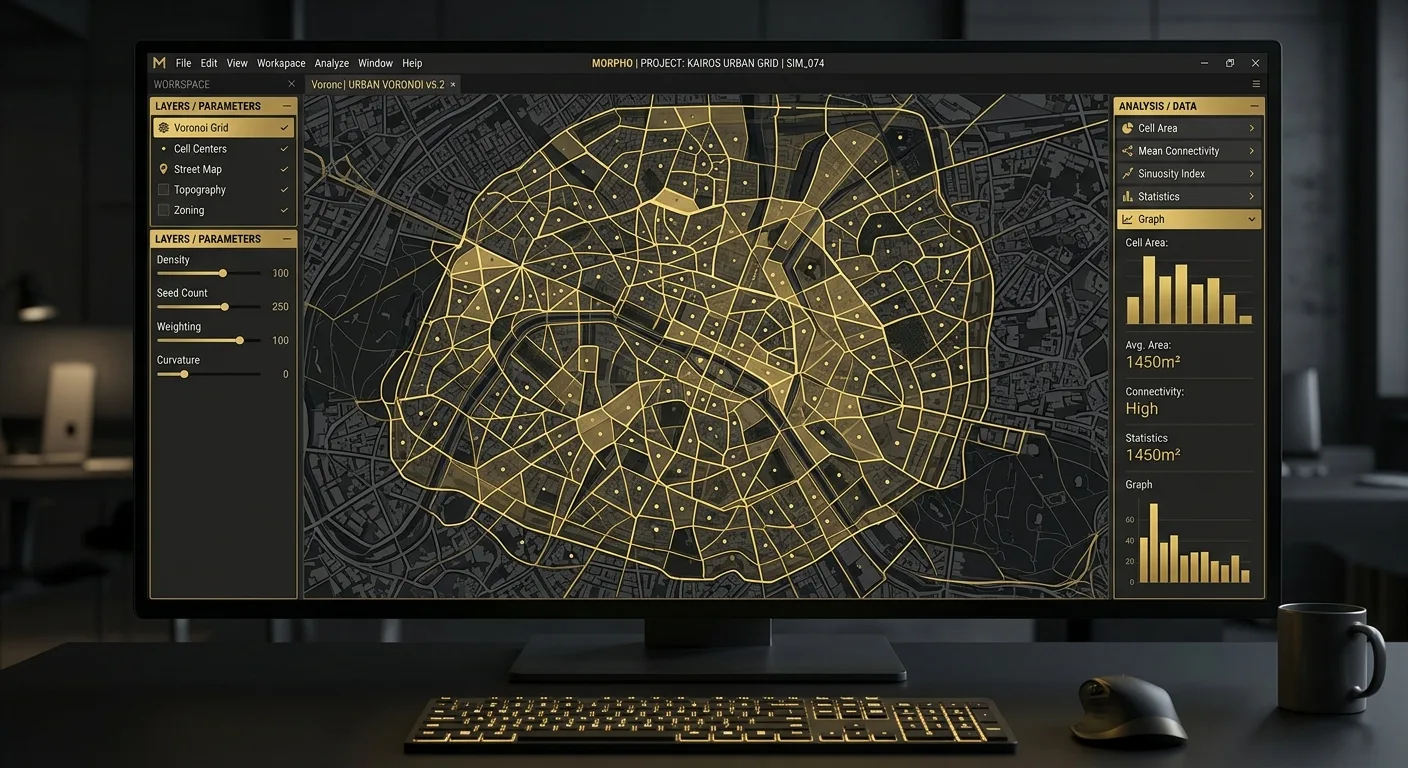
The conventional urban grid is a powerful instrument of control. It enables rapid subdivision of land, efficient infrastructure routing, and legible address systems. It also tends to produce a particular spatial quality: uniform block sizes, right-angle intersections, and a visual monotony that corresponds to a real impoverishment of spatial experience at street level. The grid is a solution to a specific set of administrative and infrastructural problems, and it performs those functions well. What it does less well is respond to the particularities of a site: its topography, its movement patterns, its existing social geographies, its ecological conditions.
The Voronocity research program emerged from the recognition that parametric design tools had matured to the point where an alternative urban geometry (one derived from the actual distribution of use, movement, and spatial relationships on a given site) could be generated, tested, and refined within a design research process. The Voronoi diagram, a mathematical structure with origins in geometry and applications across geography, biology, and materials science, provides the computational basis for this alternative.
The Mathematics of Proximity
A Voronoi diagram divides a plane into regions according to proximity: given a set of seed points, each region contains all the locations that are closer to its seed point than to any other. The boundaries between regions are equidistant from neighboring seed points. The resulting geometry is organic in appearance (irregular polygons with varying proportions and orientations) but mathematically precise and completely determined by the initial distribution of seed points.
Applied to urban design, this mathematical structure offers a way to derive block geometry from the distribution of existing or proposed attractors: transit nodes, public spaces, employment concentrations, natural features, heritage structures. The Voronoi boundaries that emerge from this distribution define block edges that are spatially efficient in a specific sense: they minimize average travel distance from any point within a block to the nearest attractor. Accessibility is built into the geometry of the urban form itself.
The parametric quality of the system (the fact that the geometry responds algorithmically to changes in seed point distribution) enables designers to explore a wide range of urban configurations systematically. Moving a seed point, adding a new attractor, or adjusting the weighting assigned to different attractor types generates a different urban geometry, and the performance implications of that geometry can be evaluated immediately against accessibility, daylight, wind, and other environmental criteria.
From Plan to Tower: The Voronocity Studies
The Voronocity research program developed through studies at increasing scales of resolution, from the urban plan to the individual tower typology. The plan studies established the methodology: mapping existing conditions, identifying seed points that would generate a Voronoi geometry responsive to those conditions, and testing the resulting block structure against performance metrics.
The cultural centre studies explored how Voronoi geometry could organize a complex multi-programmatic building, treating the spatial boundaries between program elements (performance spaces, galleries, workshops, public circulation) as Voronoi cell boundaries derived from relational distances between functional attractors in the brief. The tower studies (developed across types designated T1 through T4) applied Voronoi logic to the vertical dimension of high-density development. The structural and spatial organization of each floor was derived from a Voronoi subdivision of the floor plate, with cell boundaries corresponding to structural walls, circulation routes, or service zones. The result is a tower section that varies in response to changing programmatic and structural demands across its height, rather than repeating an identical floor plate.
Organic Form and Structural Efficiency
The organic appearance of Voronoi geometry is not merely aesthetic. The mathematical properties of the diagram (in particular, the fact that Voronoi boundaries are always perpendicular to the lines connecting neighboring seed points) produce structural geometries with genuine performance advantages in certain loading conditions.
Shell structures derived from Voronoi tessellations distribute applied loads through compression along the cell edges, avoiding the bending moments that are structurally inefficient and materially expensive. For spatial structures covering large areas (roof systems, long-span floor plates, facade structures), the Voronoi shell provides a path to structural efficiency through geometric optimization. The research into shell structures developed in parallel with the Voronocity program explores precisely this potential: the derivation of structural surface geometry from mathematical optimization rather than compositional intuition.
This connection between mathematical geometry and structural efficiency is one of the deeper themes of the Voronocity research. The best urban form and the best structural form share a common logic: they both emerge from the optimization of relationships (between uses, between loads, between people and resources) rather than from the imposition of a predetermined formal language. The Voronoi diagram is a tool for making those relationships visible and buildable.
Collaborative Design and the Research Collective Model
The Voronocity program could not have been developed through conventional architectural practice. The iterative nature of the research (the systematic variation of seed point distributions, the evaluation of structural and environmental performance across dozens of geometric configurations, the development of connection details for systems derived from the geometry) required a mode of practice organized around research questions rather than client commissions.
This is the model of the design research collective: a group of practitioners maintaining a shared research agenda across projects, competition entries, and speculative studies, accumulating knowledge that no single commission could generate. The global reach of such collectives provides access to the range of structural typologies, climatic conditions, and cultural programs that tests a research agenda’s robustness. The Voronocity studies were exhibited at architecture biennales and published in design research surveys precisely because they demonstrated what this mode of practice produces: work that is simultaneously speculative and technically rigorous.
Parametric Urbanism and the Limits of the Algorithm
A responsible account of parametric urban morphology must engage with its limitations. The quality of Voronoi-derived geometry depends entirely on the quality of the input: the identification of seed points, the weighting of attractors, the definition of the optimization objective. Cities are not optimizable in the way that a structural section is. They are sites of contest, negotiation, and historical accumulation; their spatial qualities are the product of layered decisions made by actors with different interests and different information.
A parametric approach that reduces this complexity to proximity metrics and movement flows risks producing cities that are spatially coherent but socially thin. The Voronocity research program has consistently acknowledged this limitation. The mathematical geometry provides a starting point, not a final answer. The role of the designer (drawing on social sensibility as well as technical intelligence) is to evaluate the parametrically generated geometry against the full range of criteria that make a city livable: the quality of its public spaces, its legibility to inhabitants, and the capacity of its streets to support the informal uses that animate urban life.
The Research Agenda and the Built City
Research programs of this kind face a particular challenge: the distance between speculative studies and built urban form is long, and mechanisms for translating research findings into development decisions are slow. Competition entries and biennale installations generate disciplinary attention but do not by themselves change planning frameworks.
What they do, over time, is change the terms of the conversation. The emergence of Voronoi geometry in practice (in facade structures, roof systems, and urban design proposals) has made visible a formal logic not previously legible within mainstream design culture. The structural studies that developed from Voronoi shell research have influenced the engineering of spatial structures in built projects, and proximity-based urban geometry has entered academic and professional research that is beginning to inform regulatory frameworks.
The contribution of design research to the built city is diffuse and cumulative, mediated through education, publication, competition, and exhibition. The conceptual frameworks that shape how practitioners think about urban form, structural material, and ecological performance are not generated by the market. They are generated by exactly the kind of sustained, collective, research-driven practice that the Voronocity program exemplifies.