Mass Timber Engineering and Seismic Resilience in High-Rise Construction
The assumption that timber is unsuitable for tall buildings in earthquake zones has been systematically challenged through material science advances, large-scale structural testing, and design research.
For most of the twentieth century, the structural calculation for construction in seismically active zones arrived at the same answer: reinforced concrete, or steel, or some combination of the two. These materials offered predictable performance under lateral load, an established code framework, and a long record of tested behavior in major seismic events. Timber, associated in engineering memory with older, lighter construction types, was not part of the serious conversation for tall buildings in earthquake zones.
That assumption has been systematically challenged over the past decade, through a convergence of material science advances, large-scale structural testing, and design research that has treated seismic resilience and ecological performance not as competing objectives but as co-generative design constraints.
The Structural Logic of Timber Under Seismic Load
The case for mass timber in seismic contexts begins with a counterintuitive material property: weight. Seismic forces acting on a structure are proportional to its mass. A mass timber building is approximately one quarter the weight of a structurally equivalent concrete building, which means the absolute magnitude of seismic forces transmitted through the structure is substantially reduced. This mass advantage translates directly into smaller foundation requirements, reduced demand on lateral load-resisting systems, and a more favorable structural response during ground motion events.
Cross-laminated timber panels (produced by bonding successive layers of dimensional lumber at orthogonal orientations) exhibit biaxial stiffness and excellent diaphragm behavior. In platform-frame configurations, CLT floor plates distribute lateral loads across wall panels efficiently, and the composite action between floor and wall elements adds structural redundancy that pure frame systems cannot provide.
Laminated veneer lumber (LVL), produced by bonding thin wood veneers with the grain aligned parallel to the member length, offers high axial strength relative to weight and dimensional stability under varying moisture conditions. In column and beam applications within hybrid timber-concrete or timber-steel systems, LVL elements perform reliably within the elastic range that seismic design codes require for frequent ground motion intensities.
Rocking Systems and Post-Earthquake Repairability
The structural engineering innovation that has most significantly advanced the case for tall timber construction in seismic zones is the rocking wall system. Unlike conventional shear wall configurations, in which seismic energy is dissipated through distributed inelastic deformation (meaning structural damage), rocking systems are designed to respond to seismic input by rotating about their base, lifting slightly from the foundation and then returning to plumb as the motion subsides.
When implemented in timber, rocking walls offer an additional performance advantage: the damage, if any, is concentrated in replaceable energy-dissipating connectors rather than distributed through the primary structural material. After a significant seismic event, repair work can be targeted precisely, avoiding the costly and difficult process of assessing concealed damage in a concrete or steel shear core.
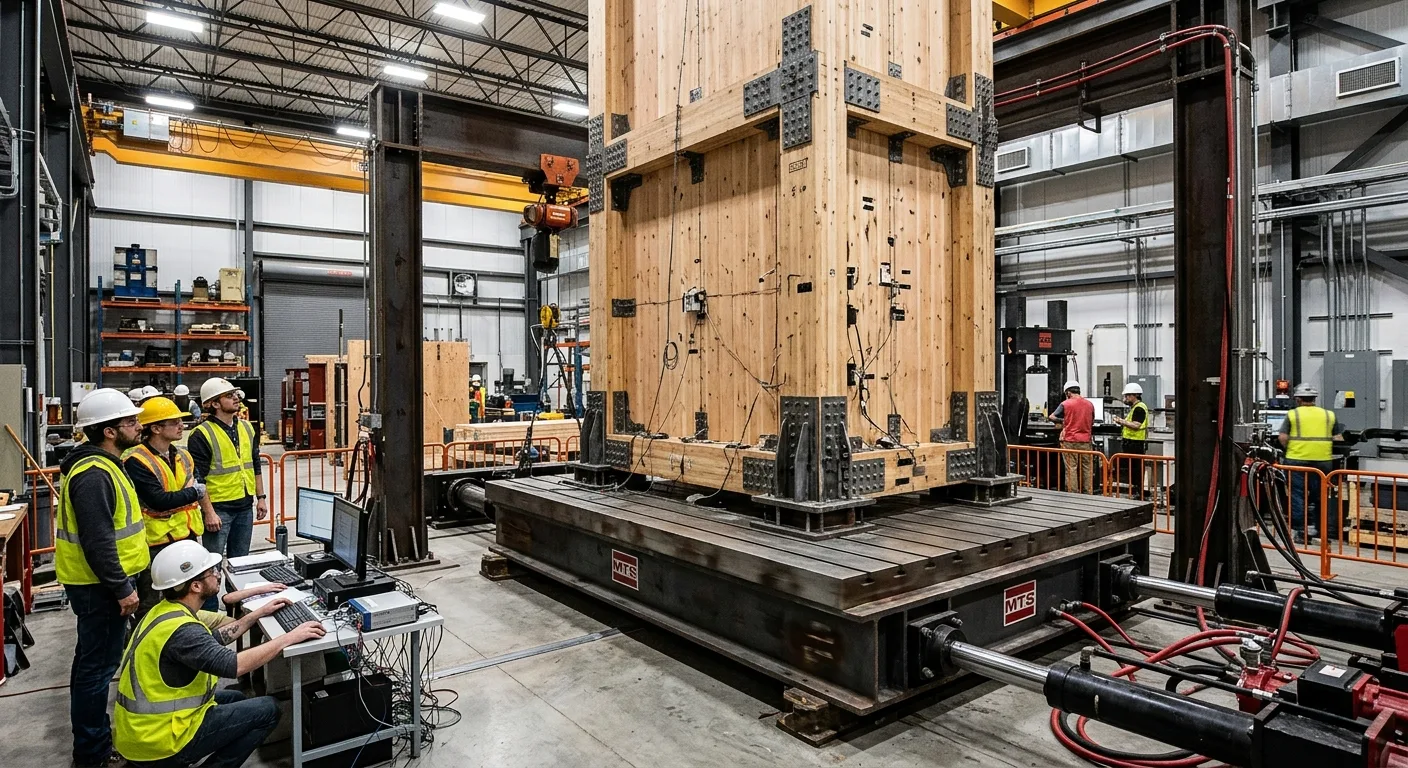
Research conducted at the University of Washington and tested at the shake table facility at the University of California San Diego has demonstrated this performance at ten-story scale: the tallest timber structure ever subjected to large-scale seismic testing as of the time of publication. The results confirmed that a timber rocking wall system designed for a Seattle seismic hazard profile performed within predicted parameters, with damage that was minimal and localized to intended fuse elements.
The Shibaura Island Research Problem
The design research project developed around the Shibaura Island site in Tokyo represents one of the more rigorous attempts to apply these structural insights within a real urban development context. Shibaura Island is a high-density mixed-use precinct on reclaimed land in Tokyo Bay, a challenging site condition that combines soft alluvial soils, high seismic hazard, and the programmatic complexity of a mixed residential and commercial development.
The design research addressed the earthquake-resistant mixed-use tower typology as a specific problem domain: how to achieve the carbon performance and spatial quality benefits of engineered timber construction within a structural system that can satisfy the demanding seismic code requirements of a major Japanese metropolitan area.
The approach drawn from this research lineage combines a hybrid structural strategy (retaining a concrete or steel core where seismic performance and fire resistance requirements are most stringent, while deploying engineered timber for the gravity frame, floor plates, and facade structure) with a rigorous approach to connection detailing that treats each structural junction as a potential seismic fuse.
Fire Performance and Code Evolution
No discussion of timber in tall buildings can proceed without addressing fire performance. Mass timber behaves under fire conditions in a predictably different way from light-frame construction. Large cross-sections char at a stable rate (typically 0.6 to 0.7 millimetres per minute for CLT) while the uncharred wood beneath retains its structural capacity. Fire engineering for mass timber is therefore a calculation exercise with established parameters.
The most recent International Building Code cycle includes provisions for mass timber in buildings up to 18 stories, and hybrid mass timber and concrete buildings have been completed at 25-story height in North America. What remains an active research area is fire behavior at building interfaces: connections between timber structural elements and concrete cores, and between exposed and encapsulated timber surfaces. These details determine whether a timber building performs as modeled, and they benefit precisely from the iterative, research-driven approach to connection design that characterizes the most advanced work in this field.
Folded Structures and Material Efficiency
One structural typology that has emerged from research into solid wood systems deserves particular attention: the folded plate or folded arch configuration. Folded solid wood structures achieve their load-carrying capacity through geometry rather than material quantity. The form itself acts as a structural mechanism, distributing loads along the fold lines and generating shell behavior from planar elements.
The structural efficiency of folded timber systems is significant. By engaging the geometry in carrying load, sections can be reduced relative to conventional beam-and-column configurations, and the resulting form generates spatial quality that flat-slab construction cannot. The folded arch in solid wood extends this principle to three-dimensional form-finding: a structural surface that carries load primarily through compression and in-plane shear, with flexural demand concentrated at the support conditions.
These systems are not primarily seismic-resistant strategies; their primary performance advantage is structural efficiency in gravity and wind load cases. But they represent the broader design research commitment to treating structural form as an architectural resource: choosing forms that do more with less material, that generate spatial and environmental qualities as a direct consequence of their load-carrying mechanism.
Toward an Integrated Resilience Framework
The convergence of seismic engineering research, material science, and design research is producing a more sophisticated understanding of what structural resilience means within ecological architecture. Resilience is not merely the capacity to survive a seismic event without collapse. It includes the capacity for rapid return to occupancy (which points to rocking and fusing structural strategies) and the capacity for a building to contribute to its urban context over a long service period without the material-intensive interventions that conventional construction demands at mid-life.
Timber buildings designed to this integrated standard can be both structurally resilient and materially reversible. The connection details that enable seismic performance can, with foresight in the design process, also enable disassembly and material recovery. Lightweight foundations enabled by reduced structural mass accommodate future building modification more readily than deep concrete equivalents. This convergence requires sustained investment in design research: the iterative development of structural systems and connection typologies through competition entries, speculative projects, and collaborative work that defines the working method of a practice genuinely committed to advancing the field.