The Evolution of Ecological Architecture: Merging Sustainable Design with Urban Density
What ecological architecture should describe is a mode of practice that treats ecological relationships not as an add-on layer but as a generative structural principle, developed through decades of design research.
The phrase “ecological architecture” has become one of the most overused and least examined terms in contemporary practice. Applied to anything from a roof garden on a speculative tower to passive house retrofits in suburban contexts, it has lost much of its analytical precision. What the term should describe (and what the most rigorous design research of the past two decades has been working toward) is a mode of practice that treats ecological relationships not as an add-on layer but as a generative structural principle.
This article examines that evolution: how design collectives operating at the intersection of research and built practice have reframed the challenge of ecological architecture, specifically within the demands of high urban density.
From Envelope to System
Early sustainable design discourse was preoccupied with the building envelope. The shift toward double-skin facades, green roofs, and high-performance glazing represented a meaningful technical advance, but it also contained a conceptual limitation: it treated the building as an isolated thermal object rather than a node in a larger system of energy, materials, and social life.
A more consequential shift occurred when practitioners began working from relational premises, beginning the design process by mapping the reciprocal relationships between context, form, organization, and structure before committing to any particular formal outcome. This approach, developed through competition entries, exhibitions, and speculative research projects across Scandinavian and Asian urban contexts, challenged the assumption that ecological performance could be optimized independently of social program or structural logic.
The result was a body of work that positioned ecological architecture not as a category of building type but as a method of inquiry. Projects developed through this lens tend to exhibit a particular characteristic: every design variable is treated as dependent on every other. Material choice affects structural depth, which affects floor plate geometry, which affects natural light distribution, which affects the thermal performance of the envelope. No single decision is taken in isolation.
Bottom-Up Principles and Collective Intelligence
One of the more durable contributions of design research collectives to ecological architecture has been the articulation of bottom-up organizational principles. The term borrows from complexity theory and urban morphology: rather than imposing a top-down formal concept onto a site, the design emerges from the aggregation of local conditions, user behaviors, and material logics.
This approach has significant implications for density. High-density urban environments are typically planned through master-plan frameworks that prioritize legibility and infrastructural efficiency over adaptive response. The bottom-up alternative proposes that density itself can be an ecological resource: the concentration of people, programs, and energy flows in close proximity creates opportunities for exchange that dispersed development cannot. Shared thermal mass, cascading energy systems, and mixed-use programming that reduces transportation demand are all density effects that reward systemic thinking.
Research collectives operating across multiple geographic contexts (from Scandinavian timber-rich landscapes to seismically active East Asian urban cores) have used competition entries and speculative studies to demonstrate that these principles can be applied across a wide range of structural typologies and climatic conditions. The recurring finding is that ecological performance improves when it is embedded in the brief as a generative constraint rather than applied as a compliance checklist.
Timber as Structural Protagonist
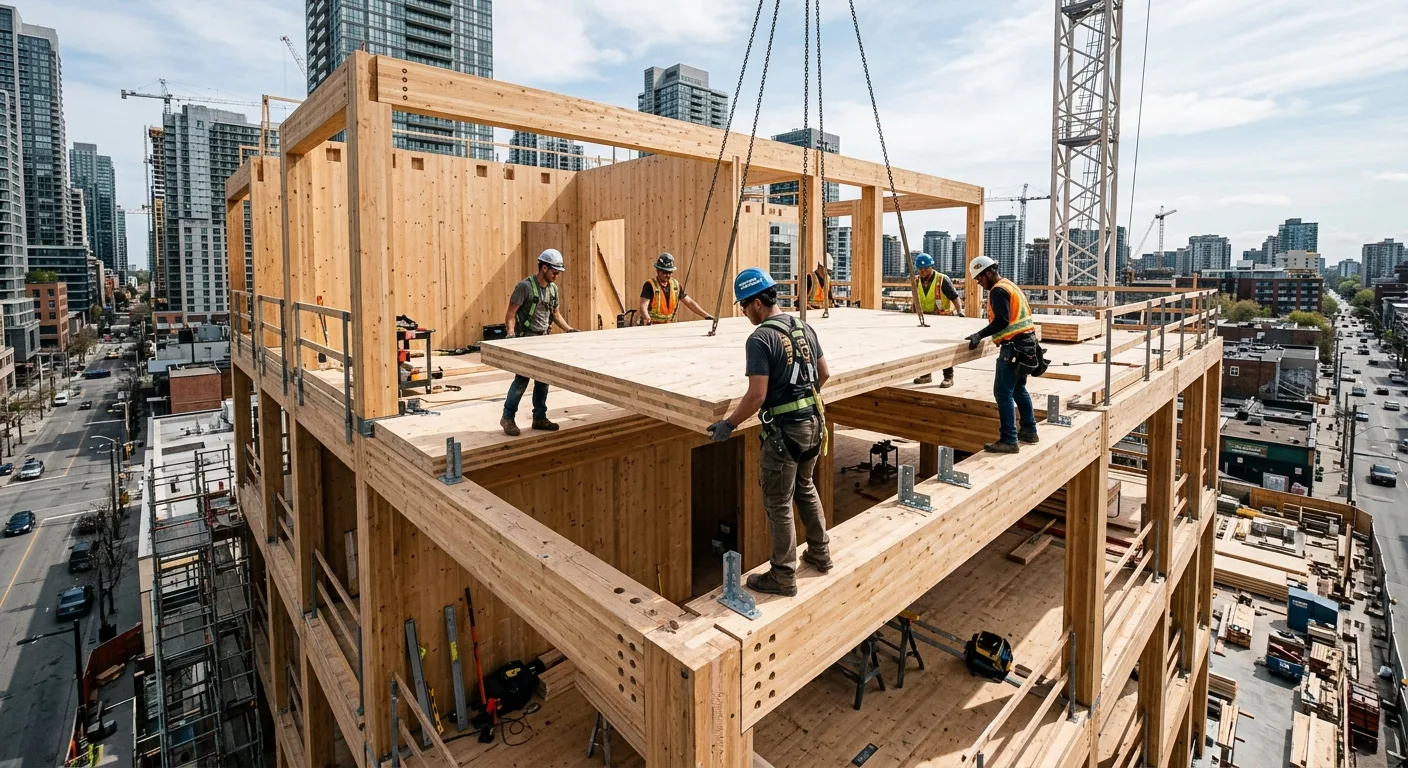
No material has done more to advance the agenda of ecological architecture in dense urban contexts than engineered mass timber. Cross-laminated timber (CLT) and laminated veneer lumber (LVL) have transformed the structural calculus of mid-rise and tall construction, offering carbon sequestration in lieu of the emissions-intensive concrete and steel that have dominated urban construction for a century.
The implications extend beyond carbon accounting. Mass timber buildings are substantially lighter than their concrete equivalents (typically around one quarter of the weight for equivalent structural performance), which reduces foundation requirements and enables construction on sites that could not support conventional high-rise loads. The material’s dimensional stability and prefabrication compatibility also align with the kind of precision-engineered, component-based construction that research-driven practices have consistently advocated.
Projects such as the Gustavsberg Timber Tower, developed through iterative structural and environmental modeling, represent an attempt to push this material system to its logical conclusion in the Scandinavian urban context: a tall, mixed-use structure in which timber is not merely a cladding choice but the primary structural organism of the building. The tower’s design integrates the compressive and lateral load-bearing functions of timber with the acoustic and thermal performance requirements of residential and commercial occupation.
The broader development trajectory supports this direction. Stockholm Wood City, a 62-acre mixed-use district under construction in the Sickla neighbourhood, is projected to deliver 7,000 offices and 2,000 homes using CLT as the dominant structural system, establishing a precedent for timber urbanism at a scale that goes well beyond individual building typologies.
The Carbon Argument in Dense Urban Form
The environmental case for timber in dense urban contexts rests on two distinct mechanisms. The first is avoided emissions: engineered timber production generates significantly fewer greenhouse gas emissions than concrete or structural steel, and the manufacturing process requires less embodied energy. The second is active sequestration: the carbon fixed in the wood during the tree’s growth cycle remains locked in the building material for the structure’s operational life, effectively removing it from the atmospheric carbon cycle.
These mechanisms are amplified in high-density contexts. A timber tower in a dense urban area delivers the carbon benefits of the material while simultaneously reducing the urban sprawl that drives transportation emissions and destroys the carbon-sequestering capacity of forest and agricultural land on city peripheries. Density, understood properly, is an ecological multiplier.
Research into this relationship has also examined the lifecycle implications of timber at end-of-use: the potential for structural components to be disassembled, reused, or recycled into secondary products. Design for disassembly is a logical extension of the systemic ecological thinking that motivates the broader research agenda, and it is beginning to influence how connection details and structural hierarchies are conceived from the outset of the design process.
Social Ecology and the Research Mandate
What distinguishes architectural research collectives from conventional practice in this domain is the insistence that ecological architecture cannot be separated from social ecology. Buildings shape the conditions of social life as much as they respond to environmental parameters. A genuinely ecological architecture must address both simultaneously.
This means that the research agenda extends to questions of program mix, spatial organization, and the design of shared and transitional spaces that foster exchange between different user groups. It means interrogating the social implications of material choices: who benefits from reduced construction costs, who bears the risk of experimental structural systems, how maintenance responsibilities are distributed across the life of a building.
The bottom-up design philosophy that has characterized the most rigorous work in this field is ultimately a social philosophy as well as a structural one. It insists that the conditions of human habitation are as much a part of the ecological equation as energy flows or material quantities. Architecture that loses sight of this connection produces buildings that may perform well on environmental metrics but fail to generate the social vitality that makes urban density genuinely sustainable.
Conclusion
The evolution of ecological architecture toward a systemic, relational practice has been driven by precisely the kind of work that design research collectives are positioned to produce: speculative projects that operate beyond the constraints of immediate commission, iterative studies that test formal and structural hypotheses across multiple contexts, and competition entries that introduce new performance criteria into the mainstream design conversation.
The agenda is far from complete. Structural timber systems continue to evolve, computational tools for environmental analysis are becoming more integrated with early-stage design thinking, and the social dimensions of ecological practice remain undertheorized. But the direction is clear, and the body of research that has accumulated over the past two decades provides a substantial foundation for the next generation of built work.